This is the Grade 10 Technology and Livelihood Education (TLE) self-learning module for Carpentry NC II, Quarter 1, Module 2: Prepare Tools, Equipment and Materials for Staking-out Building Lines (Identifying properties and defects of wood). It is an Alternative Delivery Mode (ADM) module from DepEd Cordillera Administrative Region for learners studying at home. After it, learners can describe what makes wood strong and useful for building and spot the defects that make lumber a poor choice.
What learners will learn
The module’s learning competency is: Prepare tools, equipment and materials for staking out building lines (TLE_IACP9-12BLIa-h-1).
After going through the module, learners are expected to:
- identify the properties of wood for staking out building lines;
- describe wood defects; and
- value the importance of using wood of good quality.
The module has one lesson, “Identifying properties and defects of Wood.”
Why wood quality matters
The module explains that wood is the most important material in building formworks. A carpenter has to pick the right lumber for each part of the forms and spot defects that can cause failures during assembly. Knowing the properties of wood helps you choose good, quality lumber. As the module puts it, quality should never be compromised by cheap but defective lumber.
Physical properties of wood
- Strength: the ability of wood to resist stresses and strain. This includes resistance to compression along the fiber, stiffness (resisting bending, as in floor joists and beams), strength in tension (resisting lengthwise pull), and shearing strength (the fibers resisting rupture across the grain).
- Moisture: strength increases, to a point, as wood is seasoned (dried). Moisture content is the ratio of the mass of water in wood to the mass of the same sample of dry wood. Shrinkage happens when wood loses moisture below the fiber saturation point.
- Knots: their size, character, and location affect strength. In a beam, knots on the upper surface weaken it less than knots on the lower part.
- Weight: heavy wood is usually strong; light wood is usually weak.
- Hardness: resistance to indentation or to the saw or ax across the grain. It depends on weight, structure, and seasoning.
- Durability: the ability to resist decay, or how long a timber lasts under given conditions.
- Cleavability: the resistance of wood to splitting along the grain.
- Color: helps identify wood. Heartwood is usually darker than sapwood.
- Permeability: influenced by the anatomy of wood cells.
- Mass properties: conductivity, heat, and coefficient of thermal expansion.
- Electrical properties: dielectric constant and dielectric power factor.
Mechanical properties of wood
- Elasticity: depends on grain orientation, moisture, species, temperature, and rate of loading.
- Strength: depends on rate of loading, species, moisture content, orientation, temperature, and natural features such as knots.
- Vibration: damping and sound velocity are the two main vibration effects that matter in structures.
Common wood defects
Wood defects are abnormalities that lower the economic or decorative value of wood and reduce its strength. The main defects include knots, cracks, fungal damage, warping, slanting grain, and wormholes.
| Defect | What it looks like |
|---|---|
| Crook or crown | Board bent end-to-end along its edge, down its length |
| Bow | Board that rocks end to end when laid on one face |
| Cupping | Face warps up across the width, like a shallow letter U when seen from the end; often from one side drying faster |
| Checking | Lengthwise crack, usually from drying too fast |
| Split | Lengthwise separation of fibers that goes through to the opposite face |
| Wane | Bark present, or wood missing, on the corners of a piece |
| Blue stain | Discoloration that goes into the fiber, usually blue or brown; light, medium, or heavy |
| Machine burn | Darkened wood from overheated machine knives or rolls |
| Pitch | Resin (gum or sap) on the surface or in pockets below it |
| Tight knot | Knot held firmly in the surrounding wood |
| Wood bores | Holes made by insects and beetles |
| Twist | Warping where the two ends turn in opposite directions |
The pretest also covers basic staking-out tools and materials: a bolo to cut pegs, a sledge hammer to drive them, a chalk line for marking straight lines on long lumber, and nylon string (tansi) for laying out building lines over the batter board. Lumber is defined as a milled or processed piece of wood ready to use.
How to use this module
The module follows these parts in order:
- What I Know: a 15-item multiple-choice pretest. Answer it before anything else.
- What’s New, Activity 1 “How do you do?”: list carpentry tools, materials, and equipment you can find at home and write their uses.
- What Is It: the discussion of wood properties and defects.
- What’s More, Activity 2: name the wood defect shown in each of eight pictures.
- What I Have Learned, Activity 3 “Hunt Me”: a word search of terms from the lesson.
- What I Can Do, Activity 4 “Draw Me”: draw the types of wood defects, rated by a rubric on knowledge, drawing accuracy, organization, completeness, and cleanliness (Excellent 95-100 down to Poor 75-80).
- Post-Assessment: 15 multiple-choice items.
- Additional Activity, Activity 5 “Reality Check”: short answers on what a wood defect is, the mechanical properties of wood, and why the topic matters to carpentry students.
For learners: write all answers in your activity notebook or on a separate sheet, not on the module. Check your work honestly with the answer key at the end, and return the module to your teacher when you finish.
For parents: you are the main support at home. Help your child follow the parts in order and keep the module clean.
For teachers and facilitators: orient learners on using the module, track their progress, and remind them to use separate answer sheets.
Frequently asked questions
What grade and quarter is this module for?
It is for Grade 10 TLE learners taking Carpentry NC II, Quarter 1, Module 2.
What competency does this module cover?
It covers preparing tools, equipment and materials for staking out building lines, with the code TLE_IACP9-12BLIa-h-1.
Does the module have an answer key?
Yes. The answer key at the end covers the pretest, the defect identification activity, and the post-assessment. Other activities are marked answers may vary or are rated by rubric.
What is the difference between bow and crook?
A bowed board rocks from end to end when laid on one face. A crook or crown is a board bent end-to-end along its edge as it runs down its length.
What is moisture content of wood?
It is the ratio of the mass of water in a piece of wood to the mass of the same sample when dry. When wood loses moisture below the fiber saturation point, it shrinks.
Full text of the module
The text below is a transcription of the PDF above, as printed.
Technology and Livelihood Education Quarter 1 – Module 2: Prepare Tools, Equipment and Materials for Staking-out Building Lines (Identifying properties and defects of wood)
10
Technology and Livelihood Education
Quarter 1 – Module 2
Prepare Tools, Equipment and Materials for Staking-out Building Lines
(Identifying properties and defects of wood)
CARPENTRY NC II
[illustration: children reading and learning under a tree, a teacher helping students at a desk, a child reading by a lantern, and a globe]
CO_Q1_TLE 10_Module 2
10
Technology and Livelihood Education
Quarter 1 – Module 2
Prepare Tools, Equipment and Materials for Staking-out Building Lines
(Identifying properties and defects of wood)
CARPENTRY NC II
TLE Carpentry – Grade 10
Alternative Delivery Mode
Quarter 1 – Module 2: Prepare Tools, Equipment and Materials for Staking-out Building Lines (Identifying properties and defects of wood)
First Edition, 2020
Republic Act 8293, section 176 states that: No copyright shall subsist in any work of the Government of the Philippines. However, prior approval of the government agency or office wherein the work is created shall be necessary for exploitation of such work for profit. Such agency or office may, among other things, impose as a condition the payment of royalties.
Borrowed materials (i.e., songs, stories, poems, pictures, photos, brand names, trademarks, etc.) included in this module are owned by their respective copyright holders. Every effort has been exerted to locate and seek permission to use these materials from their respective copyright owners. The publisher and authors do not represent nor claim ownership over them.
Published by the Department of Education
Secretary: Leonor Magtolis Briones
Undersecretary: Diosdado M. San Antonio
Development Team of the Module
Writer: Nestor O. Dawaton
Editors:
Reviewer: Jonalyn C. Ambrona Martina Tibangay Baby Lourdes Balian
Illustrator:
Layout Artist:
Management Team: Estela Leon-Cariño Carmel F. Meris Rosita C. Agnasi Romulo A. Galnawan Evelyn G. Ganotice Martina L. Tibangay Noel D. Diosan
Printed in the Philippines by:
Department of Education – Cordillera Administrative Region
Office Address: Wangal, La Trinidad, Benguet
Telefax: (074) -422 -4074
E-mail Address: car@deped.gov.ph
Introductory Message
This Self-Learning Module (SLM) is prepared so that you, our dear learners, can continue your studies and learn while at home. Activities, questions, directions, exercises, and discussions are carefully stated for you to understand each lesson.
Each SLMS is composed of different parts. Each part shall guide you step-by-step as you discover and understand the lesson prepared for you.
Pre-tests are provided to measure your prior knowledge on lessons in each SLM. This will tell you if you need to proceed on completing this module or if you need to ask your facilitator or your teacher’s assistance for better understanding of the lesson. At the end of each module, you need to answer the post-test to self-check your learning. Answer keys are provided for each activity and test. We trust that you will be honest in using these.
In addition to the material in the main text, Notes to the Teacher are also provided to our facilitators and parents for strategies and reminders on how they can best help you on your home-based learning.
Please use this module with care. Do not put unnecessary marks on any part of this SLM. Use a separate sheet of paper in answering the exercises and test. And read the instructions carefully before performing each task.
If you have questions in using this SLM or any difficulty in answering the tasks in this module, do not hesitate to consult your teacher or facilitator.
Thank you.
Notes to the Teacher
This contains helpful tips or strategies that will help you in guiding the learner.
For the facilitator:
Hi, as a facilitator you are expected to orient the learners on how to use this module. You also need to keep track of the learners’ progress while allowing them to manage their own learning. Kindly, advise the learner’s parents or guardians of the same procedure since they will be the primary supporters in the learners’ progress. Please, do not forget to remind the learner to use separate sheets in answering all of the activities found in the learning module.
For the learner:
Hello learner, Welcome to the Carpentry NC II Alternative Delivery Mode (ADM) Module on Identifying properties and defects of wood. I hope you are ready to progress in your Grade 10 TLE in Carpentry NC II with this learning module. This is designed to provide you with interactive tasks to further develop the desired learning competencies prescribed in our curriculum. With this, you are expected to appreciate staking through the information and activity given.
This module has the following parts and corresponding icons:
| ICON | LABEL | DETAIL |
|---|---|---|
| [illustration: icon] | What I Need to Know | This contains the learning objectives which you need to accomplish. |
| [illustration: icon] | What I know | This evaluates what you know about the lesson you are to learn. |
| [illustration: icon] | What’s In | This connects the current lesson with a topic necessary in your understanding. |
| [illustration: icon] | What’s New | This introduces the lesson through an activity. |
| [illustration: icon] | What Is It | This contains a brief discussion of the learning module lesson. |
| [illustration: icon] | What’s More | These are activities to check your understanding of the lesson. |
| [illustration: icon] | What I Have Learned | This summarizes the important ideas presented in the lesson. |
| [illustration: icon] | What I Can Do | This is a real-life application of what you have learned. |
| [illustration: icon] | Assessment | This is a post assessment of what you have learned. |
| [illustration: icon] | Additional Activity | This is an activity that will strengthen your knowledge about the lesson. |
At the end of this module you will also find:
References
This is a list of all sources used in developing this module.
TABLE OF CONTENTS
What I Need to Know ……………………………………….Error! Bookmark not defined.
What I Know ………………………………………………………………………………………….2
What’s In ………………………………………………………………………………………………3
What’s New ……………………………………………………………………………………………3
What Is It………………………………………………………………………………………………4
What’s More…………………………………………………………………………………………..8
What I Have Learned ……………………………………………………………………………….9
What I Can Do ……………………………………………………………………………………..10
Post-Assessment …………………………………………………………………………………..11
Additional Activity …………………………………………………………………………………12
Answer Key ………………………………………………………………………………………….13
References …………………………………………………………………………………………..14
Lesson 1: Identifying properties and defects of Wood
The following are some reminders in using this module:
- Use the module with care. Do not put unnecessary mark/s on any part of the module. Use a separate sheet of paper in answering the exercises.
- Don’t forget to answer What I Know before moving on to the other activities included in the module.
- Read the instruction carefully before doing each task.
- Observe honesty and integrity in doing the tasks and checking your answers.
- Finish the task at hand before proceeding to the next.
- Return this module to your teacher/facilitator once you are through with it.
If you encounter any difficulty in answering the tasks in this module, do not hesitate to consult your teacher or facilitator. Always bear in mind that you are not alone.
We hope that through this material, you will experience meaningful learning and gain deep understanding of the relevant competencies. You can do it!
What I Need to Know
This module was designed and written to guide you to acquire the learning competencies and develop your skills in preparing tools, equipment and materials for staking-out building lines. The scope of this module permits it to be used in many different learning situations. The language used recognizes the diverse vocabulary level of students. The lessons are arranged to follow the standard sequence of the course. However, the order in which you read the module can be changed to correspond with the textbook you are now using.
Learning Objectives: Prepare tools, equipment and materials for staking out building lines (TLE_IACP9-12BLIa-h-1)
After going through this module, you are expected to:
- identify the properties of wood for staking out building lines;
- describe wood defects; and,
- value the importance of using wood of good quality.
What I Know
Pre-Test
Multiple Choice.
Directions. Read the following questions carefully, select the letter of the correct answer and write in your activity notebook.
It is the warping of lumber where the ends twist in opposite direction.
- A. Bow
- B. Crock
- C. Twist
- D. Wane
It is the longitudinal separation of the fibers which extends to the opposite face of a piece of sawn timber.
- A. Cupping
- B. Split
- C. Twist
- D. Crock
Is the ratio of the mass of water contained in the mass of the same sample of dry wood?
- A. Moisture content
- B. Shrinkage
- C. Density
- D. Mass
Mechanical properties of wood include ____________________________.
- A. Elasticity
- B. Vibration
- C. Strength
- D. All of these
It is used to cut pegs for stake out.
- A. Bolo
- B. Cross cut saw
- C. Knife
- D. adze
It is a milled or processed piece of wood and ready to use.
- A. Plywood
- B. Lumber
- C. Timber
- D. Plank
It is used for marking straight lines on a long piece of stock or lumber.
- A. Pencil
- B. Chalk
- C. Chalk line
- D. Charcoal
It is use to drive pegs for stake out.
- A. Claw hammer
- B. Framing hammer
- C. Ball peen hammer
- D. Sledge hammer
A material used for laying out building lines over the batter board.
- A. Nylon String /Tansi
- B. Plastic twine chord
- C. Chalk line
- D. Nails
It occurs when wood loses moisture below the fiber saturation point.
- A. Cleavability
- B. Knot
- C. Permeability
- D. Shrinkage
It is the resistance of wood to cleavage along the grain.
- A. Cleavability
- B. Knot
- C. Permeability
- D. Shrinkage
It is the wood defects caused by insects.
- A. Crack
- B. Crock
- C. Twist
- D. Wood bores
It is influenced by the anatomy of wood cells.
- A. Cleavability
- B. Knot
- C. Permeability
- D. Shrinkage
Which of the following is NOT a wood defect?
- A. Bow
- B. Crook or Crown
- C. Knot
- D. Shearing Strength
Wood defects ___
- A. are abnormalities in wood.
- B. lower the economic value of wood
- C. reduce the strength of wood
- D. all of the above
What’s In
This Module is a useful document which you can use to add more knowledge and skills that you acquired in the previous lesson. It includes instructions and procedure on how to perform the different learning outcomes. The unit of competency contains the knowledge, skills, and attitudes required to know the physical, defects and properties of wood for staking-out building lines course. You are required to go through a series of learning activities in order to complete each of the learning outcomes of this module.
What’s New
Activity 1. How do you do?
Copy the template in your activity notebook and fill with the needed information. List the different tools, materials and equipment which you can see in your house and write its uses according to what you know.
| Name of tools, materials and equipment use in Carpentry | Write each use according to its specification. |
|---|---|
What Is It
Wood is obviously both a common and a historical choice as a building material. However, in the past few decades, there has been a move away from wood in favor of engineered products or metals like aluminum.
While the desire to not rely on the world’s forests for building demands is well-intentioned, the advantages of wood as a building material still outweigh other products on the market when looking at the environmental impact and performance.
In the construction of formworks wood is the most important material needed. You will be selecting the appropriate lumber for every part of the forms. You also need to learn how to identify the different defects of wood which may cause unnecessary failures in the assembling process.
Knowing the physical properties of wood can help guide us in choosing good, quality lumber for our carpentry works. In this lesson, we will not only learn the different physical properties of wood, we will also discuss the different kinds of wood defects that we need to look out for and avoid. Quality should never be compromised by cheap but defective lumber.
PHYSICAL PROPERTIES OF WOOD
1. Strength Physically, wood is strong and stiff but, compared to a material like steel, it’s also light and flexible. It has another interesting property too. Metals, plastics, and ceramics tend to have a fairly uniform inner structure and that makes them isotropic: they behave exactly the same way in all directions. Strength is the general term used in reference to the ability of wood to resist stresses and strain. Different wood varies materially in the following manner.
a. Wood is resistant to compression along the fiber. b. Stiffness or the ability to resist bending as in floor joist and beam supporting heavy load. c. Strength in tension or the ability to resist in lengthwise d. Shearing strength or the ability of the fibers to resist rupture along across the grain
2. Moisture is an important factor in strength of wood, thus to a certain extent, strength increase with the degree of seasoning of wood
a. MOISTURE CONTENT is the ratio of the mass of water contain in the mass of same sample of dry wood. b. SHRINKAGE occurs when wood loses moisture below the fiber saturation point.
3. Knots or other defects also influence strength. The size, character and location of the knots are important. EXAMPLE in cross bending strength, knots on the upper surface of the beam do not detract from the strength as much as on the lower part of the beam
4. Weight of wood is also important, Heavy wood are usually strong and light wood are usually weak.
5. Hardness is expressed as resistance to indentation or to the saw or ax across the grain. Hardness dependent largely on weight, structure elements of the wood and degree of seasoning.
6. Durability as applied to wood, means the ability to resist decay or simply the length of life of a certain timber under given conditions.
7. Cleavability is the resistance of wood to cleavage along the grain.
8. Color is often a means of identification of wood, as mentioned earlier, heartwood is generally much darker in color than sapwood.
9. Permeability is influence by the anatomy of wood cells.
10. Mass properties of wood are conductivity, heat and coefficient of thermal expansion.
11. Electrical properties of wood are dielectric constant and the dielectric power factor alternating current.
MECHANICAL PROPERTIES OF WOOD
1. ELASTICITY of wood depends on grain orientation, moisture, species, temperature, and rate of loading
2. STRENGTH depends upon the rate of loading species, moisture, contents, orientation, temperature, size and location of natural characteristics such as knots and species size.
3. VIBRATION damping and sound velocity are two primary vibration phenomena of interest in structural application.
WOOD DEFECTS
Wood defects are abnormalities which tend to lower the economic value or decorative value of wood and also reduces the strength of wood. The main defects of wood include knots, cracks, fungal damage, warping, slanting of grain, and wormholes. A knot is a part of a branch embedded in wood.
A crook or crown is a defect found in a board that is bent end-to-end in the direction of the tall ends of a board as it continues down the length of the board.
[illustration: board bent end-to-end, curving along its length]
Bow A board that rocks from end to end when laid on one face. Curvature is formed in direction of the length of the sawn timber.
[illustration: board curving along its length when laid on one face]
Cupping This often occurs when one side dries faster the other. Where the face of a board warps up across its width such that if one looks at the end of the board, it will look like a shallow letter “U”.
[illustration: board with edges curled up across its width]
Checking A crack in the wood structure of a piece, running lengthwise usually caused by rapid seasoning.
[photo: two wood boards with lengthwise cracks]
Split A longitudinal separation of the fibers which extends to the opposite face of a piece of sawn timber.
[illustration: board with a lengthwise split through its thickness]
Wane The presence of bark or absence of wood on corners of a piece of lumber.
[photo: lumber piece with bark-edged corner]
Blue Stain A discoloration that penetrates the wood fiber. It can be any color other than the natural color of the piece in which it is found. It is classified as light, medium, or heavy and is generally blue or brown.
[photo: boards with blue stain discoloration]
Machine Burn A darkening of the wood due to overheating by the machine knives or rolls when pieces are stopped in a machine.
[photo: board with dark burn mark across its surface]
Pitch An accumulation of resinous material on the surface or in pockets below the surface of wood. It is also called gum or sap.
[photo: board with resin pocket on its surface]
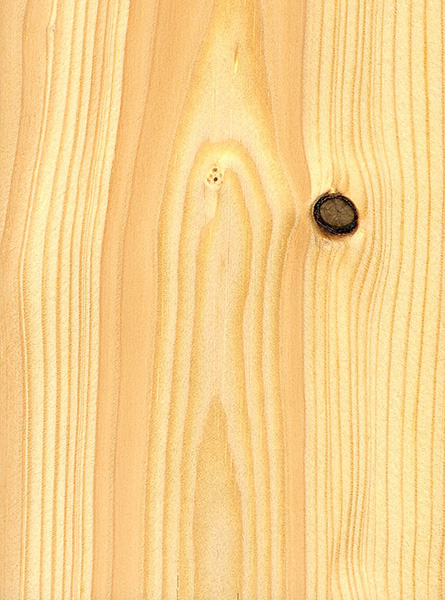
Tight Knot A knot fixed by growth or position in the wood structure so that it firmly places in the its surrounding wood.
[photo: tight knot in a wood surface]
Wood bores Holes in the wood caused by insects and beetles.
[photo: board with small round holes made by insects]
Twist Warping in lumber where the ends twist in opposite directions.
[illustration: board with ends twisted in opposite directions]
What’s More
Activity 2: Identification of Wood Defects
Direction: Identify the wood defects as shown on the picture below. Write your answer on your activity notebook.
[illustration: board with ends twisted in opposite directions]
[illustration: board curved along its length, bent up at the ends]
[illustration: board with a lengthwise split through its thickness]
[photo: board with dark burn mark across its surface]
[illustration: board curving along its length when laid on one face]
[illustration: board with edges curled up across its width]
[photo: lumber piece with bark-edged corner]
[photo: board with small round holes made by insects]
What I Have Learned
Activity 3: HUNT ME
Directions: Hunt the words in the box associated in our lesson. Write your answers in your Activity Notebook.
transcriber’s note: the printed grid has no header row and no word list appears on the page; the empty header row below is a formatting placeholder only.
| N | O | M | G | O | K | U | G | D | A | Z | X | W | C | L |
| R | I | W | T | S | P | M | C | S | J | N | S | O | H | S |
| X | O | V | T | S | E | Z | E | G | V | C | X | U | E | T |
| B | B | R | M | I | I | R | S | R | S | E | Z | P | C | R |
| W | U | L | W | X | L | W | O | G | U | D | K | B | K | E |
| A | T | G | U | S | J | P | T | B | Z | T | I | P | I | N |
| N | P | M | F | E | F | S | S | F | D | P | S | H | N | G |
| E | Q | Z | U | T | S | L | S | C | N | O | I | I | G | T |
| F | V | N | A | M | O | T | G | E | R | Z | O | T | O | H |
| W | L | D | H | C | V | N | A | N | N | O | G | W | C | M |
| J | N | A | W | R | P | S | K | I | I | D | O | Q | J | H |
| F | V | L | F | D | Z | E | Q | B | N | P | R | K | T | Q |
| N | R | U | B | E | N | I | H | C | A | M | P | A | R | G |
| J | C | V | G | R | V | R | G | Q | N | Q | I | U | H | B |
| E | I | Y | O | C | H | B | N | E | M | S | K | D | C | L |
transcriber’s note: the pages supplied begin partway through the module, so the module’s full title is not printed on them and no
#title is given here. The printed page numbers (10 to 15) are omitted as page furniture.
What I Can Do
Activity 4. DRAW ME
In a sheet of paper, draw the types of wood defects. Your output will be rated using the rubric below.
| Criteria | Excellent | Good | Fair | Poor |
|---|---|---|---|---|
| Knowledge | Subject knowledge is evident throughout the project. All information is clear, appropriate, and correct | Subject knowledge is evident in much of the project. Most information is clear, appropriate, and correct. | Some subject knowledge is evident. Some Information is confusing, incorrect, or flawed. | Subject knowledge is not evident. Information is confusing, incorrect, or flawed. |
| Drawing Accuracy | Drawing looks perfect with no technical problems. For example, there are no errors in measurement, style. | The sequence of information is logical. Views and Labels of most information are clear | The sequence of information is somewhat logical. | The sequence of information is not logical. Views are not evident. |
| Drawing Organization | The sequence of drawing information is correct. | Project runs adequately with minor technical problems. | Project runs minimally. There are many technical problems when viewing the project. | Project does not run satisfactorily. There are too many technical problems to view the project. |
| Completeness | The project shows total completeness. | The project is mostly complete. | The work shows Some level of completeness | The work is a minimally completed. |
| Cleanliness | The project shows total cleanliness. | The project is mostly clean. | The work shows some level of cleanliness | The work is a minimally clean. |
Legend:
| SCALE | DISCRIPTION | POINTS |
|---|---|---|
| 4 | Excellent | 95-100 |
| 3 | Good | 86-94 |
| 2 | Fair | 81-85 |
| 1 | Poor | 75-80 |
Post-Assessment
Multiple Choice. Directions. Read the following questions carefully, select the letter of the correct answer and write in your activity notebook.
Mechanical properties of wood include ____________________________.
- A. Elasticity
- B. Vibration
- C. Strength
- D. All of these
It is used to cut pegs for stake out.
- A. Knife
- B. Cross cut saw
- C. Bolo
- D. adze
Wood defects ___
- A. are abnormalities in wood
- B. lower the economic value of wood
- C. reduce the strength of wood
- D. all of the above
It is a milled or processed piece of wood and ready to use.
- A. Lumber
- B. Plywood
- C. Timber
- D. Plank
It is used for marking straight lines on a long piece of stock or lumber.
- A. Pencil
- B. Chalk line
- C. Chalk
- D. Charcoal
It is the longitudinal separation of the fibers which extends to the opposite face of a piece of sawn timber.
- A. Cupping
- B. Split
- C. Twist
- D. Crock
It is use to drive pegs for stake out.
- A. Claw hammer
- B. Framing hammer
- C. Ball peen hammer
- D. Sledge hammer
A material used for laying out building lines over the batter board.
- A. Nails
- B. Plastic twine chord
- C. Chalk line
- D. Nylon String /Tansi
It occurs when wood loses moisture below the fiber saturation point.
- A. Shrinkage
- B. Knot
- C. Permeability
- D. Cleavability
It is the resistance of wood to cleavage along the grain.
- A. Cleavability
- B. Knot
- C. Permeability
- D. Shrinkage
Is the ratio of the mass of water contained in the mass of the same sample of dry wood?
- A. Moisture content
- B. Shrinkage
- C. Density
- D. Mass
It is the wood defects caused by insects.
- A. Crack
- B. Crock
- C. Twist
- D. Wood bores
It is the warping of lumber where the ends twist in opposite direction.
- A. Bow
- B. Crock
- C. Twist
- D. Wane
It is influenced by the anatomy of wood cells.
- A. Cleavability
- B. Knot
- C. Permeability
- D. Shrinkage
Which of the following is NOT a wood defect?
- A. Bow
- B. Crook or Crown
- C. Knot
- D. shearing Strength
Additional Activity
Activity 5. Reality Check
Answer the following questions about properties and defects of wood. Write your answer in your activity notebook.
What is wood defect?
What are the mechanical properties of wood?
What are the benefits of this topics especially in carpentry students? and why?
Answer Key
transcriber’s note: this page is printed upside down. The answers below are read from the rotated page.
What I Know: Pre-test
- C
- B
- A
- D
- A
- B
- C
- D
- A
- D
- A
- D
- C
- D
- D
What’s New
Answers may vary
What’s More
- Twist
- Crook
- Split
- Machine burn
- Bow
- Cupping
What I Have Learned
Answers may vary
What I Can Do
Refer to Rubric
Post Assessment
- D
- C
- D
- A
- B
- B
- D
- D
- A
- A
- A
- D
- C
- C
- D
Additional Activity
Answers may vary
References
Competency Based Learning Materials (CBLM) Carpentry NC II, 2009
Fajardo Jr., Max B. Simplified Methods on Building Construction, second edition. Quezon City: 5138 Merchandizing, 1983.


https://i.pinimg.com/originals/c2/a1/89/c2a1897938c1b4ff067acfd255842108.jpg

https://woodproducts.onlineexpos.com/media/keys/292/1.jpg

http://images.meredith.com/wood/images/2007/03/p_crookdefect.jpg

https://www.wood-database.com/wp-content/uploads/pitch-pine-sealed.jpg

For inquiries or feedback, please write or call:
Department of Education – Bureau of Learning Resources (DepEd-BLR) Ground Floor, Bonifacio Bldg., DepEd Complex Meralco Avenue, Pasig City, Philippines 1600 Telefax: (632) 8634-1072; 8634-1054; 8631-4985 Email Address: blr.lrqad@deped.gov.ph * blr.lrpd@deped.gov.ph Telefax: (632) 8634-1072; 8634-1054; 8631-4985
Leave a Reply