This is a Senior High School self-learning module for Health Optimizing Physical Education 1 (HOPE 1), Quarters 1 and 2, Module 3: “Set Fitness Goal: Engaging in Moderate to Vigorous Physical Activity.” It was developed by DepEd Region IV-A CALABARZON (First Edition, 2021) for home-based learning. By the end, learners should be able to take their own heart rate, tell moderate from vigorous activity, and build a personal fitness plan using the FITT principle.
What learners will learn
The module has one lesson, “Engaging in Moderate to Vigorous Physical Activities following Personalized Fitness Plan.” After it, learners are expected to:
- explain the importance of muscle, bone, and aerobic exercise
- learn the techniques in getting the heart rate
- differentiate moderate intensity and vigorous intensity
- identify exercises that are essential for boosting fitness
- enumerate the principles of exercise
- proficiently perform fitness activity
- show creativity and enjoyment while doing a personalized fitness plan
Key ideas: types of exercise and heart rate
Aerobic exercise is any activity that makes you sweat, breathe harder, and raises your heart rate compared with rest. It is rhythmic, uses large muscle groups, and can be kept up for at least 10 minutes. Aerobic fitness is the body’s ability to supply energy during continuous activity such as biking and running.
Other types of exercise in the module:
- Muscular strength: the muscles’ ability to exert force, such as when lifting weights.
- Muscular endurance: how many times you can lift a certain weight.
- Bone strengthening: weight-bearing activities like jumping, walking, jogging, and weightlifting.
- Resistance training: weight lifting, push-ups, and crunches using dumbbells or body weight.
- Circuit training: alternating between about five to 10 exercises that target different muscle groups.
- Flexibility exercises: stretching done in warm-up and cool-down. Static stretching is held for 10 to 30 seconds and comes in active and passive forms. Dynamic stretching is stretching with movement and suits the pre-workout phase.
The module teaches four places to take your pulse:
| Site | Where |
|---|---|
| Apical | Heel of the hand over the left side of the chest |
| Carotid | Beside the larynx (never check both sides at once) |
| Radial | Wrist, in line with the thumb |
| Temporal | Left or right temple |
For the carotid, radial, and temporal sites, use light pressure from the tips of the pointer and middle fingers.
Key ideas: intensity and the principles of exercise
Moderate-intensity activity (about 3 to 6 METs) takes moderate effort and noticeably raises the heart rate. Examples include brisk walking, dancing, gardening, and housework. Vigorous-intensity activity (more than 6 METs) causes rapid breathing and a big rise in heart rate. Examples include running, fast cycling, aerobics, and competitive sports.
To find your target heart rate, subtract your age from 220 to estimate your maximum heart rate.
- Moderate: 64% to 76% of maximum. For a 50-year-old, that is 220 – 50 = 170 bpm, so the target is 109 to 129 bpm.
- Vigorous: 77% to 93% of maximum. For a 35-year-old, that is 185 bpm, so the target is 142 to 172 bpm.
A normal resting heart rate is 60 to 100 beats per minute, and lower is better. Besides pulse, learners record push-ups done at a time, seated forward reach, waist circumference, and BMI.
The principles of exercise are:
- Individual differences: one size does not fit all.
- Specificity: train the skill you want to improve, so a runner trains by running.
- Overload: the body must work against a greater-than-usual load to improve.
- Progression: increase the workload gradually and allow rest to avoid injury.
- Adaptation: the body adjusts to demands, so routines need variety.
- FITT: Frequency, Intensity, Time, and Type of exercise.
Activities in the module
- What’s In: a personal profile (heart rate, BMI, height, weight) and a pyramid for ranking five fitness goals.
- What’s New: a fact-or-myth quiz on exercise beliefs and questions on a physical activity pyramid.
- What’s More: sorting activities into aerobic, muscular strength, and bone strengthening, plus case problems for naming the principle applied.
- What I Have Learned: matching exercises to body parts and sentence completion.
- What I Can Do: a sample FITT fitness plan, a blank plan to fill in, and a weekly moderate and vigorous activity log.
- Additional Activities: a Zumba performance task scored with a four-criterion rubric.
How to use this module
Learners: Start with the 15-item pretest (What I Know) to check what you already know. Then work through each part in order and finish with the 15-item Assessment. Write all answers on a separate sheet of paper, not on the module. Answer keys are included; use them honestly to check your work.
Parents: Help your child find a safe, well-ventilated space for the fitness activities. Support the weekly activity log and the community Zumba task.
Teachers: The fitness plan, the activity log, and the Zumba rubric work well as outputs to collect. Review the printed answer key before using it. Several answers do not match the lesson. For example, pretest item 1 is keyed as Zumba, though the lesson defines that as aerobic exercise. Assessment item 15 is keyed D, though the lesson gives 77% to 93%.
Frequently asked questions
What grade and quarter is this HOPE 1 module for?
It is a Senior High School module for Health Optimizing Physical Education 1, covering Quarters 1 and 2. This is Module 3.
What is the difference between moderate and vigorous intensity?
Moderate-intensity activity needs moderate effort and noticeably raises the heart rate, at 64% to 76% of maximum heart rate. Vigorous-intensity activity needs a large effort and causes rapid breathing, at 77% to 93% of maximum heart rate.
How do I compute my maximum heart rate?
Subtract your age from 220. For example, a 35-year-old has an estimated maximum heart rate of 185 beats per minute.
What does FITT stand for?
FITT stands for Frequency (how often), Intensity (how hard), Time (how long), and Type (what kind) of exercise. Learners use it to build their own fitness plan.
Does the module have an answer key?
Yes, it has answer keys for the pretest, the What’s More activities, and the assessment. Several printed answers do not match the lesson, so check them against the discussion.
Full text of the module
The text below is a transcription of the PDF above, as printed.
Health Optimizing Physical Education 1 Quarters 1 and 2 – Module 3: Set Fitness Goal: Engaging in Moderate to Vigorous Physical Activity
Senior High School
[illustration: students studying outdoors under a tree, a teacher helping students at a desk, a student reading beside a globe, and a child studying by lantern light]
CO_Q1-2_HOPE1 SHS Module 3
Health Optimizing Physical Education 1 (H.O.P.E 1) Alternative Delivery Mode Quarters 1 and 2 – Module 3: Set Fitness Goal: Engaging in Moderate to Vigorous Physical Activities First Edition, 2021
Republic Act 8293, section 176 states that: No copyright shall subsist in any work of the Government of the Philippines. However, prior approval of the government agency or office wherein the work is created shall be necessary for exploitation of such work for profit. Such agency or office may, among other things, impose as a condition the payment of royalties.
Borrowed materials (i.e., songs, stories, poems, pictures, photos, brand names, trademarks, etc.) included in this module are owned by their respective copyright holders. Every effort has been exerted to locate and seek permission to use these materials from their respective copyright owners. The publisher and authors do not represent nor claim ownership over them.
Published by the Department of Education Secretary: Leonor Magtolis Briones Undersecretary: Diosdado M. San Antonio
Development Team of the Module
Writers: Maria Hayde P. Martinez, Neil Lloyd A. Pulan Editors: Aleli C. Nitoral, Roderick Tobias Reviewers: Raine P. Ramos, Lorelyn P. Arellano, Celeste A. Cortez, John Lester Guerrero, Amy D. Orig, Romnick Nicolas, Jenna Joy B. Dela Rosa Illustrator: Roderick B. Blando Layout Artist: Mark John B. Diocado, Florendo S. Galang Management Team: Francis Cesar B. Bringas, Job S. Zape, Jr., Ramonito Elumbaring, Reicon C. Condes, Elaine T. Balaogan, Fe M. Ong-ongowan, Cherrylou D. Repia, Babylyn M. Pambid, Gloria C. Roque, Rosemarie C. Blando, Mil F. Ponciano, Meliton Berin Jr.
Printed in the Philippines by ________________________
Department of Education – Region IV-A CALABARZON
Office Address: Gate 2 Karangalan Village, Barangay San Isidro Telefax: 02-8682-5773/8684-4914/8647-7487 E-mail Address: lrmd.calabarzon@deped.gov.ph
Health Optimizing Physical Education 1
Quarters 1 and 2 – Module 3:
Set Fitness Goal:
Engaging in Moderate to Vigorous Physical Activity
Senior High School
Introductory Message
This Self-Learning Module (SLM) is prepared so that you, our dear learners, can continue your studies and learn while at home. Activities, questions, directions, exercises, and discussions are carefully stated for you to understand each lesson.
Each SLM is composed of different parts. Each part shall guide you step-by-step as you discover and understand the lesson prepared for you.
Pre-tests are provided to measure your prior knowledge on lessons in each SLM. This will tell you if you need to proceed on completing this module or if you need to ask your facilitator or your teacher’s assistance for better understanding of the lesson. At the end of each module, you need to answer the post-test to self-check your learning. Answer keys are provided for each activity and test. We trust that you will be honest in using these.
In addition to the material in the main text, Notes to the Teacher are also provided to our facilitators and parents for strategies and reminders on how they can best help you on your home-based learning.
Please use this module with care. Do not put unnecessary marks on any part of this SLM. Use a separate sheet of paper in answering the exercises and tests. And read the instructions carefully before performing each task.
If you have any questions in using this SLM or any difficulty in answering the tasks in this module, do not hesitate to consult your teacher or facilitator.
Thank you.
What I Need to Know
[illustration: hand pointing at a button, icon beside the part title]
This module was designed and written with you in mind. Exercise is a physical activity that one does to maintain a healthy body. It helps enhance one’s health and well-being when done regularly. The scope of this module can be used in various learning situations. The lessons include different principles on improving one’s health and are arranged in a sequence that allows the student to gradually learn the lesson. This module focuses on the lesson entitled:
- Lesson 1 – Engaging in Moderate to Vigorous Physical Activities following Personalized Fitness Plan
After going through this module, you are expected to:
- explain the importance of muscle, bone, and aerobic exercise
- learn the techniques in getting the heart rate
- differentiate moderate intensity and vigorous intensity
- identify exercises that are essential for boosting fitness
- enumerate the principles of exercise
- proficiently perform fitness activity
- show creativity and enjoyment while doing personalized fitness plan
What I Know
[illustration: hand holding a pencil, icon beside the part title]
Directions: Choose the letter of the best answer. Write the chosen letter on a separate sheet of paper.
What is any physical activity that makes you sweat, causes you to breathe harder, and gets your heart beating faster compared to when you are at rest?
- A. Aerobics
- B. Aerobic Exercise
- C. Aerobic Fitness
- D. Zumba
What is the ability of body’s cardiovascular system to supply energy during continuous physical activities such as biking and running?
- A. Aerobics
- B. Aerobic Exercise
- C. Aerobic Fitness
- D. Zumba
How many seconds are needed to hold your position in doing the static stretching?
- A. 20 seconds
- B. 30 seconds
- C. 40 seconds
- D. 50 seconds
Which of the following does not show a sedentary lifestyle?
- A. brisk walking
- B. doing a cross stitch
- C. playing video games
- D. texting a friend
Which is an example of vigorous physical activity?
- A. ball dribbling
- B. calf stretching
- C. jog in place
- D. mountain climbing
In performing hip-hop aerobics, what fitness component is required?
- A. agility
- B. cardio endurance
- C. coordination
- D. speed
Which of the following can be obtained from the left or right temple with light pressure from the tips of the pointer and middle fingers?
- A. Apex
- B. Carotid
- C. Radial
- D. Temporal
Which refers to repeated practice of a skill or activity that eventually leads of body’s cardiovascular system and makes the muscles perform it with ease?
- A. Adaptation
- B. Overload
- C. Progression
- D. Specificity
What percentage of the maximum heart rate should be the target in performing moderate-intensity physical activity?
- A. 64% and 76%
- B. 64% and 76%
- C. 64% and 90%
- D. 64% and 95%
What type of training alternates the use of muscle groups depending on the body part being targeted?
- A. Circuit training
- B. Resistance training
- C. Workout training
- D. Yoga training
What type of stretching is most often recommended for general fitness because it involves slowly stretching into a position and holding for 10 to 30 seconds before slowly releasing the stretch?
- A. Ballistic
- B. Dynamic
- C. Passive
- D. Static
What exercise uses muscle strength in a coordinated manner to stabilize movements and reduce the risk of injuries?
- A. Balance exercise
- B. Flexibility exercise
- C. Muscle exercise
- D. Warm up exercise
Which is NOT part of the preparations before doing exercise?
- A. Drink plenty of water
- B. Wear a dress that is absorbent
- C. Find a place where there is enough ventilation
- D. Prepare a music that will motivate you to work out
What is the advisable number of minutes and days to work out per week?
- A. 20 to 30 min. 2X a week
- B. 30 to 45 min. 3 X a week
- C. 30 to 60 min. 3X a week
- D. 60 to 2 hrs. 1x a week
What physical activity measures the amount of weight that one can lift at a time?
- A. Aerobic exercise
- B. Balance exercise
- C. Muscular endurance
- D. Muscular strength
Lesson 1
Engaging in Moderate to Vigorous Physical Activities Following Personalized Fitness Plan
Understanding the importance of engaging in moderate to vigorous physical activity is considerably a great habit in achieving good health and fitness, but it does not end there. As you engage in physical activity, you will meet and interact with other people, making you more sociable, making you more sociable
What’s In
Getting To Know
| Name: | Age: | BMI: |
|---|---|---|
| Resting Heart Rate: | Gender: | Height: |
| Maximal Heart Rate: | No. of Heart beat/min: | Weight: |
You are supposed to design a personalized fitness plan and setting a fitness goal is your first step. Here are some of the fitness goals that will help you decide and achieve your fitness plan. Arrange the following goals according to the level of importance, putting on the top of the pyramid the goal you consider most important and, on the bottom, the least important.
- ✓ Improve cardiovascular fitness
- ✓ Body-fat weight loss
- ✓ Build more muscle
- ✓ Feel better/improved health
- ✓ Enjoyment
[illustration: blank five-tier pyramid with colored levels, for ranking the fitness goals]
What’s New
Activity 1. The following statements are common beliefs about exercise. Write F if you think it is a fact; write M if it is a myth. Write your answer on a separate paper.
_____1. Working out on an empty stomach is often considered a good weight-loss method.
_____2. If you are not sweating, you will never lose weight and there is no use to exercise.
_____3. Stretch before you exercise because it will condition your muscle.
_____4. Aerobic exercise boosts your metabolism.
_____5. Running burns calories.
Activity 2. Study the fitness pyramid below. Answer the questions that follow.
[chart: pyramid diagram; ACTIVITYPYRAMID]
Top tier: Watching TV; Computer Games; Sitting for more than 30 minutes at a time
Tier labeled LEISURE ACTIVITIES, 1-3 TIMES A WEEK: Golf; Bowling; Billiard; Yard work
Tier labeled FLEXIBILITY AND STRENGTH, 1-3 TIMES A WEEK: Stretching / Yoga; Ballet / Monkey bars; Push-Ups / Curl-Ups; Weight Lifting; Rowing
Tier labeled AEROBIC EXERCISE, 4-6 TIMES A WEEK: Swimming; Jogging; Bicycling; Brisk walking
Tier labeled RECREATIONAL, 4-6 TIMES A WEEK: Soccer / Basketball; Martial Arts; Hiking / Dancing; Tennis
Bottom tier labeled EVERYDAY: Playing outside; Walk the dog; Take the stairs; Cleaning the house; Walking to school; Walking to the store; Work in the garden
- What activities are included in the pyramid?
- What timeline is indicated in the pyramid?
- Why do you think it is important to perform different types of physical activities?
What is It
Aerobic Exercise
Aerobic Exercise is any physical activity that makes you sweat, causes you to breathe harder, and gets your heart beating faster compared to when you are at rest. Doing aerobic exercises regularly strengthens your heart and lungs and trains your cardiovascular system to manage and deliver oxygen more quickly and efficiently throughout your body Aerobic exercise, rhythmic in nature, uses your large muscle groups and can be maintained continuously for at least 10 minutes and can be maintained continuously for at least 10 minutes.
Accurate measurement of exercise heart rate is crucial in monitoring exercise intensity. In order to measure the heartbeat per minute, one must be knowledgeable of the specific points in the body where the heartbeat can be felt. There are four techniques in getting the heartbeat per minute, and they are as follows.
Apical site – is taken at the apex of the heart and can sometimes be felt very clearly by placing the heel of the hand over the left side of the chest.
[illustration: chest outline showing the apex of the heart circled]
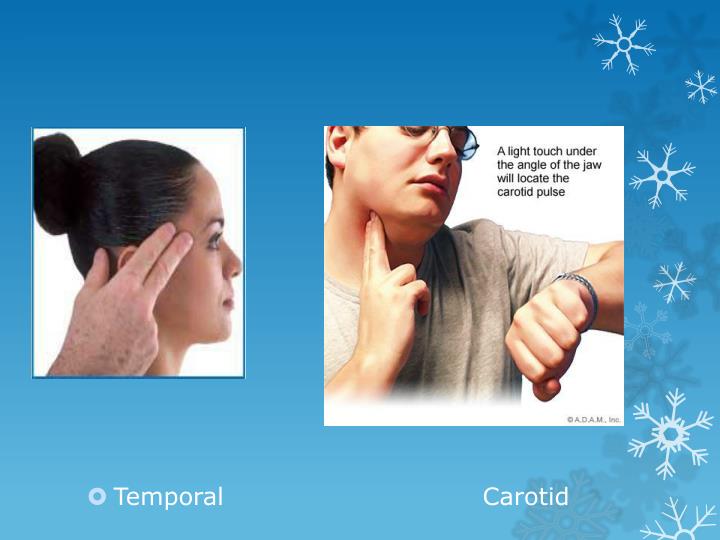
• Carotid pulse site – is taken from the carotid artery just beside the larynx using light pressure from the tips of the pointer and middle fingers. Remember; never check both carotid arteries at the same time.
[illustration: side view of a neck with two fingers on the carotid artery]
Radial pulse site – is taken from the radial artery at the wrist, in line with the thumb, using tips of the pointer and middle fingers.
[illustration: hand with fingers on the wrist at the radial pulse, circled]
Temporal pulse site – can be obtained from the left or right temple with light pressure from the tips of the pointer and middle fingers
[illustration: fingers placed on the temple of a head in profile]
Aerobic fitness is the ability of the body’s cardiovascular system to supply energy during continuous physical activities such as biking and running. Studies show that this type of exercise provides many health benefits such as decreasing risk for heart disease, stroke, high blood pressure, type II diabetes and some cancers. Examples of aerobic activities include walking at a brisk pace, swimming, jogging, dancing, etc.
[illustration: group of people doing side-stretch exercises]
Muscular strength is the ability of the muscles to exert a force during an activity such as lifting weights. Muscle strengthening exercises involve using your muscles to work against a resistance such as your body weight, elastic bands or weights.
[illustration: “What is Muscular Strength & How to Improve it?” with a man lifting a barbell]
Bone strengthening exercise, or any weight-bearing activity that produces a force on the bone, is also important to overall health for children and adults. This force is usually produced by impact with the ground and results in bone growth in children and healthy maintenance of bone density in adults. Examples of bone strengthening activities include jumping, walking, jogging, and weightlifting exercises. As you can see, some exercises such as walking or jogging serve a dual purpose of strengthening our bones and our aerobic system.
[photo: woman in a sports bra lifting a dumbbell]
Muscular endurance, on the other hand, is how many times you can lift a certain amount of weight. Resistance training (also referred to as weight training or strength training) helps increase muscular strength and endurance.
[photo: four exercise positions: squat, lunge, leg raise, and push-up]
Resistance Training. Strength exercises, such as weight lifting, push-ups, and crunches, work your muscles by using resistance (like a dumbbell or your own body weight.) This type of exercise increases lean muscle mass, which is particularly important for weight loss, because lean muscle burns more calories than other types of tissue.
[photo: man lifting weights with resistance bands in a gym]
Circuit training. It is when you alternate between several exercises (usually five to 10) that target different muscle groups.
[illustration: exercise machines arranged around the words “Circuit Training”]
http://steadystrength.com/glossary/circuit-training/
Flexibility exercises stretch your muscles and may improve your range of motion at your joints. They can improve your flexibility and reduce your risk of injury during sports and other activities. It is usually done in warm-up exercise to condition the muscle and in the cooling down exercise to allow the body to gradual transition in a resting or near-resting state.
[illustration: “FLEXIBILITY EXERCISES FULL BODY” with a woman stretching; labels: Child pose, Ab stretch, Hamstring stretch, Hip flexor stretch, Standing forward bend, Glute stretch]
Static stretching is most often recommended for general fitness. With this type, you slowly ease into the position and hold for 10 to 30 seconds before slowly releasing the stretch. Static stretching should be performed with warm muscles, such as after a warm-up or at the end of a workout. There are two forms of static stretching.
[illustration: stretches labeled Hamstring/Groin Stretch, Hamstring Stretch, Achilles Tendon Stretch, Quad Stretch]
Active Static: This form of stretching is used in yoga and martial arts. The stretch is held by the strength of agonist muscles (muscles responsible for the movement). Think of the stretch across the upper body during the Warrior II pose in yoga. Your arms are extended as your back, chest, and shoulders are stretched. The muscles of the arms and shoulders are the agonist muscles that allow you to hold this stretch.
[photo: three women performing seated and standing stretches]
Passive Static: During this type of stretching, you hold the limb to perform the stretch without any assistance such as a bar or bands. Think of a standing quadriceps stretch in which you bend your leg behind you and hold the foot, pulling the heel in close to your bottom, which stretches the front of the upper thigh.
[photo: woman stretching one leg behind her]
Dynamic Stretching is stretching with movement. The body transitions gradually into a position and this movement is repeated as you increase your reach and range of motion. Research has found that dynamic stretching is less beneficial than static stretching for increasing range of motion, but unlike static stretching, it is ideal during the pre-workout phase because it gently warms muscles while also stretching them.
[illustration: four figures performing dynamic stretches: leg swing, lunge reach, side bend, and knee lift]
Intensity of physical activity
Intensity refers to the rate at which the activity is being performed or the magnitude of the effort required to perform an activity or exercise. It can be thought of as how hard a person works to perform the activity.
The intensity of different forms of physical activity varies between people. The intensity of physical activity depends on an individual’s previous exercise experience and their relative level of fitness. Consequently, the examples given below are provided as a guide only and will vary between individuals.
| Moderate-intensity Physical Activity (Approximately 3-6 METs) | Vigorous-intensity Physical Activity (Approximately >6 METs) |
|---|---|
| Requires a moderate amount of effort and noticeably accelerates the heart rate. | Requires a large amount of effort and causes rapid breathing and a substantial increase in heart rate. |
| Examples of moderate-intensity exercise include: | Examples of vigorous-intensity exercise include: |
| • Brisk walking • Dancing • Gardening • Housework and domestic chores • Traditional hunting and gathering • Active involvement in games and sports with children / walking domestic animals • General building tasks (e.g. roofing, thatching, painting) • Carrying / moving moderate loads (<20kg) | • Running • Walking / climbing briskly up a hill • Fast cycling • Aerobics • Fast swimming • Competitive sports and games (e.g. Traditional Games, Football, Volleyball, Hockey, Basketball) • Heavy shovelling or digging ditches • Carrying / moving heavy loads (>20kg) |
glycoleap.com/
How Do I Assess My Fitness Level
You probably have an idea of how fit you are but assessing and recording baseline fitness scores can give you benchmarks against which to measure your progress. To assess your aerobic and muscular fitness, flexibility, and body composition, consider recording:
✓ Start recording your pulse rate.
First Things First: Resting Heart Rate
Your resting heart rate is the number of times your heart beats per minute when you are at rest. A good time to check it is in the morning after you have had a good night’s sleep, before you get out of bed.
For most of us, between 60 to 100 beats per minute (bpm) is normal. The rate can be affected by factors like stress, anxiety, hormones, medication, and how physically active you are. An athlete or a more active person may have a resting heart rate as low as 40 beats per minute.
When it comes to resting heart rate, lower is better. It usually means your heart muscle is in better condition and doesn’t have to work as hard to maintain a steady beat. Studies have found that a higher resting heart rate is linked with lower physical fitness and higher blood pressure and body weight.
For moderate-intensity physical activity, your target heart rate should be between 64% and 76% of your maximum heart rate. You can estimate your maximum heart rate based on your age. To estimate your maximum age-related heart rate, subtract your age from 220. For example, for a 50-year-old person, the estimated maximum age-related heart rate would be calculated as 220 – 50 years = 170 beats per minute (bpm). The 64% and 76% levels would be:
- 64% level: 170 x 0.64 = 109 bpm, and
- 76% level: 170 x 0.76 = 129 bpm
This shows that moderate-intensity physical activity for a 50-year-old person will require that the heart rate remains between 109 and 129 bpm during physical activity.
For vigorous-intensity physical activity, your target heart rate should be between 77% and 93% of your maximum heart rate. To figure out this range, follow the same formula used above, except change “64 and 76%” to “77 and 93%”. For example, for a 35-year-old person, the estimated maximum age-related heart rate would be calculated as 220 – 35 years = 185 beats per minute (bpm). The 77% and 93% levels would be:
- 77% level: 185 x 0.77 = 142 bpm, and
- 93% level: 185 x 0.93 = 172 bpm
This shows that vigorous-intensity physical activity for a 35-year-old person will require that the heart rate remains between 142 and 172 bpm during physical activity.
- ✓ Record how many standard or modified pushups you can do at a time.
- ✓ How far you can reach forward while seated on the floor with your legs in front of you
- ✓ Your waist circumference, just above your hipbones
- ✓ Your body mass index to obtain your BMI
What are the principles of exercise that I can use as my guide in my fitness plan?
A successful exercise program incorporates a number of general principles to that make the training safe and effective, and help us achieve our goals.
Principle of Individual Differences
The principle of individual differences simply means that because we all are unique individuals, we will all have a slightly different response to an exercise program. This is another way of saying that “one size does not fit all” when it comes to exercise. Well-designed exercise programs should be based on our individual differences and responses to exercise. Some of these differences have to do with body size and shape, genetics, past experience, chronic conditions, injuries, and even gender. For example, women generally need more recovery time than men, and older athletes generally need more recovery time than younger athletes.
Principle of Specificity
We have all heard the phrase, “Practice makes perfect.” Well, this is the Principle of Specificity in action. This principle simply states that exercising a certain body part or component of the body primarily develops that part. The principle of specificity implies that to become better at a particular exercise or skill, you must perform that exercise or skill. A runner should train by running, a swimmer by swimming and a cyclist by cycling. While it is helpful to have a good base of fitness and to do general conditioning routines, if you want to be better at your sport, you need to train specifically for that sport.
Principle of Overload
The exercise science principle of overload states that a greater than normal stress or load on the body is required for training adaptation to take place. What this means is that in order to improve our fitness, strength or endurance, we need to increase the workload accordingly.
In order for a muscle (including the heart) to increase strength, it must be gradually stressed by working against a load greater than it is accustomed to. For adaptation to occur, the volume of exercise must overload the body in some way in line with the capacity of the individual to cope with that overload.
Principle of Progression
The principle of progression implies that there is an optimal level of overload that should be achieved, and an optimal time frame for this overload to occur. A gradual and systematic increase in the workload over a period of time will result in improvements in fitness without risk of injury. If overload occurs too slowly, improvement is unlikely, but overload that is increased too rapidly may result in injury or muscle damage. For example, the weekend athlete who exercises vigorously only on weekends violates the principle of progression and most likely will not see obvious fitness gains.
The Principle of Progression also stresses the need for proper rest and recovery. Continual stress on the body and constant overload will result in exhaustion and injury. You should not train hard all the time, as you will risk overtraining and a decrease in fitness.
Principle of Adaptation
Adaptation refers to the body’s ability to adjust to increased or decreased physical demands. It is also one way we learn to coordinate muscle movement and develop sports-specific skills, such as batting, swimming freestyle, or shooting free throws. Repeatedly practicing a skill or activity makes it second-nature and easier to perform. Adaptation explains why beginning exercisers are often sore after starting a new routine, but after doing the same exercise for weeks and months , they have little, if any, muscle soreness.
Additionally, it makes an athlete very efficient and allows him to expend less energy doing the same movements. This reinforces the need to vary a workout routine if you want to see continued improvement.
F.I.T.T. Principle
Frequency = How often you exercise Intensity = How hard you exercise Time = How long you exercise Type = What kind of exercise
The F.I.T.T. Principle is one of the foundations of exercise, a set of guidelines that help you set up a workout routine for maximum benefit.
What’s More
Activity 1: Classifying Exercises
Directions: Categorize the words or group of words in the box below as to aerobic fitness, muscular strength, and bone strengthening activities. Write each in the appropriate column.
| AEROBIC FITNESS | MUSCULAR STRENGTH | BONE STRENGTHENING |
|---|---|---|
| 1. | 5. | 8. |
| 2. | 6. | 9. |
| 3. | 7. | 10. |
| 4. |
| weightlifting exercise | watching tv | playing Mobile legends | brisk walking |
|---|---|---|---|
| dancing | swimming | push up | using treadmill |
| stretching | using elastic band | running | jogging |
Activity 2: Help Me to be Fit
Directions: The situations below are the most common problems encountered in doing physical activities. Identify the principles applied based on the provided solution to the problem.
| Principle of Exercise being applied | Problem | Solution |
|---|---|---|
| 1. | In a short program of 4 days a week, Haiven immediately develops his muscles through lifting weights, whereas his training partner Kobe is not happy because there is no change in his body. | Haiven and Kobe have different responses to the training. Kobe needs to review the program designed and made for him. |
| Hayde goes to the gym every day and always feels | Hayde needs some rest between sessions. She |
[transcriber’s note: table continued from the previous page]
| Principle of Exercise being applied | Problem | Solution |
|---|---|---|
| 2. | tired of doing it. Lately her weight has been getting lower, she is struggling to keep up in class and her body is always sore. | may also do easy sessions that focus on different parts of her body. In that way, her body has enough time to adapt before she trains again. |
| 3. | Amor gained muscle in a short span of time since she started lifting weights. After a week, she noticed that weight training did not work well on her unlike before. She has not increased her weights in the last 3 months. | Amor needs to work harder and increase the workload on her weights because her muscle has already adapted to the routine. |
| 4. | Mel has been using group fitness ‘step’ classes a lot to get ready for his cycling race coming up soon. However, his cycling times are not improving. | Mel needs to train more on his own. In order to improve his cycling, he must cycle enough and work on a specific training program to get the goal he desires. |
| 5. | Erich is on vacation. For her vacation fitness routine, she runs twice a week or 30 minutes. Before she left, she was running four times a week for around 40-60 minutes. After vacation, she can still run four times a week for around 40-60 minutes without easily get tired. | Erich got it right. She sustained the exercise, and her body already adjusted to the intensity, and was able to maintain her fitness even though she greatly reduced her total training time. |
What I Have Learned
Activity 1: Do I look Familiar?
Directions: Identify the body parts developed in doing the list of exercises below. Write it in the corresponding box. Each exercise may be written in more than one box. write it in the corresponding box. Each exercise may be written in more than one box.
- planking 2. squats 3. push-up 4.high knees jog 5. lunge
- jumping jack 7.arm circling8.leg raise 9.sit-up 10.jogging
[transcriber’s note: the four boxes are arranged in a 2 by 2 grid and are empty]
- Arm Muscle | Cardio-Respiratory
- Abdominal Muscle | Leg and glute muscle
Activity 2: Complete the statements below. Write your answer on your paper.
- I discovered that exercise is_______________________.
- I discovered that the four techniques in getting the heartbeat per minute are________________________________________________________________________.
- I believed that muscular strength and bone strengthening exercise are_______.
- I learned that moderate and vigorous physical activity are _______________________.
- Being physically fit can be ___________________________________________.
What I Can Do
Activity 1: I am now ready!
Directions: Use the FITT formula as your guide in creating your own Fitness Plan.
My Fitness Plan
| AEROBIC | FLEXIBILITY | MUSCULAR ENDURANCE | MUSCULAR STRENGTH | BALANCE | |
|---|---|---|---|---|---|
| F Frequency | 3-5 times a week | Daily Warm-up Cool down | Daily for some muscle groups 3-4 / week | 3 times a week Different muscle groups | 3-5 times a week |
| I Intensity | 60-90 % of maximum heart rate | Hold for 15-30 sec. 1-3 reps. | 15 reps Body weight 1-3 sets 8-12 exercises | 70-90 % of 1 rep max. 3-4 sets 8-12 reps 8- 12 exercises | Hold for 30 sec. 3 reps alternately Left and Right foot |
| T Time | 15-60 min. continuous activity Progressive | 15 – 20 minutes | 30- 60 min. Progressive | 15- 60 min. Progressive | 5min. 60 sec. rest after each interval |
| T Type of Exercise | Zumba Dancing Running Cycling | Static stretch Dynamic Stretch | Resistance training Body Weight Circuit Training | Resistance Training | one leg stand filler exercise |
This Fitness Plan is for you:
My Fitness Plan
| AEROBIC | FLEXIBILITY | MUSCULAR ENDURANCE | MUSCULAR STRENGTH | BALANCE | |
|---|---|---|---|---|---|
| F Frequency | |||||
| I Intensity | |||||
| T Time | |||||
| T Type of Exercise |
Activity 1.2: My Daily Physical Activity Log
Directions: Record your activity log for the whole week. Put your physical activity under … MODERATE INTENSITY if it requires moderate amount of effort or VIGOROUS INTENSITY if it requires large amount of effort and causes rapid breathing. You may add another rows for your answer.
| MODERATE INTENSITY | VIGOROUS INTENSITY |
|---|---|
| 1. | 1. |
| 2. | 2. |
| 3. | 3. |
| 4. | 4. |
Questions:
- What did you notice about the data recorded in your Daily Physical Activity Log?
- Do you consider yourself as a physically fit person? Why?
Assessment
Multiple Choices. Choose the letter of the best answer. Write the chosen letter on a separate sheet of paper.
- What does aerobic refer to?
A. How your body uses oxygen B. Limit the uses of oxygen C. The absence of oxygen D. With little available oxygen
- Which physical activity is NOT an aerobic exercise?
A. Hip-hop dancing C. Jump roping B. Jogging D. Yoga
- What type of physical activity makes you sweat, causes you to breathe harder, and gets your heartbeat faster compared to when you are at rest?
A. Aerobic Exercise C. Bone Strengthening B. Aerobic Fitness D. Muscular Strengthening
- Which of the following will not improve a personal fitness program?
A. Muscular Strengthening B. Exercising at moderate intensities C. Making your program appropriate D. Starting slowly then increasing gradually
- What is the ability of the muscles to exert a force during an activity such as lifting weights?
A. Aerobic Exercise C. Muscular Strength B. Fitness Exercise D. Power Strength
- Which one is taken from the radial artery at the wrist, in line with the thumb, using the tips of the pointer and middle fingers?
A. Apical site C. Radial pulse site B. Carotid pulse site D. Temporal pulse site
- Which of the following gets your heart pumping and your body moving? It also refers to street style dancing while you kick up your cardio with popping and locking, breaking, top rocking, jerking, freezing, spinning, and sliding.
A. Ballroom dance C. Yoga class B. Synchronize swimming D. Zumba class
Which is the most important rule in setting a fitness goal plan?
- A. Establish realistic ones.
- B. Established goals that can be achieved in a very short time.
- C. Established a frequency of 4 to 5 times per week to exercise.
- D. Established a vigorous intensity work out to see the result right away.
What is the purpose of cooling down exercise?
- A. Prepare the muscle for intense activity.
- B. Increase heart rate and breathing rate.
- C. Elevate blood pressure and increase blood flow.
- D. Allow the body to gradual transition in a near-resting state.
What type of exercise is it when you cannot say more than a few words without pausing for a breath?
- A. Moderate intensity
- B. Overload principle
- C. Progression principle
- D. Vigorous intensity
Which of the following training includes weight lifting, push ups and crunches and working muscles by using dumbbell or own body weight?
- A. Cardio Training
- B. Circuit Training
- C. Footwork Training
- D. Resistance Training
Which one refers to stretching movement wherein the body transitions gradually into a position and movement is repeated as reach and range of motion is reached?
- A. Active stretching
- B. Dynamic Stretching
- C. Passive Stretching
- D. Static Stretching
What physical activity improves your ability to control and stabilize your body’s position and benefits people who have gained or lost a lot of weight as it can throw off their center of gravity?
- A. Dancing
- B. Riding a bike
- C. Running
- D. Water exercise
For a muscle to increase strength, it must be gradually stressed by working against a load greater than it is accustomed to. Which principle is referred to in the statement?
- A. Adaptation
- B. Progression
- C. Overload
- D. Specificity
What percentage of maximum heart rate should be the target in doing vigorous-intensity workout?
- A. 77% and 93%
- B. 77% and 95%
- C. 75% and 90%
- D. 77% and 100%
Additional Activities
Want to try Zumba?
Try the 40-minute video guide found in this link https://www.youtube.com/watch?v=ijNdZZ4hgw4
Did you enjoy that dance workout? We hope you did because it is good for your health!
Performance Task
Join a Zumba workout in your community for at least once or twice a week and share with us your experience in joining the said Zumba workout.
| Rubric | 5 | 4 | 3 | 2 | 1 |
|---|---|---|---|---|---|
| 1. Performs the step patterns correctly with enthusiasm | |||||
| 2. Performs the step patterns correctly, with mastery, coordination, and proper counting | |||||
| 3. Displays proper bodylines while doing the movements | |||||
| 4. Fosters positive attitude towards the activity |
Answer Key
[transcriber’s note: this page is printed upside down; it is transcribed upright, in reading order]
What I Know
- D
- D
- A
- B
- C
- C
- D
- A
- D
- D
- C
- B
- B
- C
- A
What’s More
ACT. 1 (in any order)
- 1-4: Using treadmill, dancing, running and swimming
- 5-7: Using elastic bond, push up, weight lifting
- 8-10: Brisk walking, stretching, and jogging
ACT. 2
- Individual Diff.
- Progression
- Overload
- Specificity
- Adaptation
Assessment
- C
- B
- B
- A
- D
- B
- D
- A
- A
- A
- D
- A
- A
- B
- D
References
BOOKS
Lualhati Fernando C and Peter Fermin D. 2016. Physical Education and Health. 1st Ed. Rex Book store
Tolitol, Mangubat, Urbiztondo, Vergara. 2016. Health Optimizing Physical Education H.O.P.E. Vibal Group
INTERNET SOURCES
http://slideplayer.com/slide/6391645/22/images/50/Carotid+P
http://slideplayer.com/slide/4156943/13/images/38/Pulse+Site+Brachial+(not+shown)+Radial.j
https://image1.slideserve.com/3078800/slide4-n.jpg
https://cdn.onlinewebfonts.com/svg/img_362964.png

For inquiries or feedback, please write or call:
Department of Education – Bureau of Learning Resources (DepEd-BLR)
Ground Floor, Bonifacio Bldg., DepEd Complex Meralco Avenue, Pasig City, Philippines 1600
Telefax: (632) 8634-1072; 8634-1054; 8631-4985
Email Address: blr.lrqad@deped.gov.ph * blr.lrpd@deped.gov.ph
Leave a Reply