This is the Arts Grade 9 Quarter 3 Module 3 self-learning module, Techniques and Styles of Neoclassic and Romantic Art and its Influence to Philippine Art Forms. It is an Alternative Delivery Mode module from DepEd Region X (First Edition, 2020), written for Grade 9 learners studying at home and for the teachers and parents who guide them. After working through it, learners should be able to tell Neoclassic and Romantic artworks apart, make their own artworks in these styles, and explain how these movements shaped Philippine art.
What learners will learn
According to the module, learners are expected to:
- create artworks guided by the techniques and styles of Neoclassic and Romantic art traditions
- apply different media techniques and processes to communicate ideas, experiences, and stories that show the characteristics of the Neoclassic and Romantic periods
- evaluate works of art in terms of artistic concepts and ideas, using criteria from the Neoclassic and Romantic periods
- take part in an exhibit of completed artworks with Neoclassic and Romantic characteristics
- describe the influence of iconic Neoclassic and Romantic artists
- show the influence of the Neoclassic and Romantic periods on Philippine art forms
Lessons in this module
- Lesson 1: Elements and Principles of Arts in Neoclassical and Romantic Periods. Compares the values, subjects, techniques, lines, and textures of the two styles, introduces three types of Neoclassical architecture, and ends with sculpting and painting activities.
- Lesson 2: The Influence of Neoclassic and Romantic Artists to Philippine Art Forms. Shows how Filipino painters and sculptors such as Juan Luna, Felix Hidalgo, Guillermo Tolentino, and Napoleon Abueva carried these styles into Philippine art.
Neoclassicism versus Romanticism
The module sums up the difference in two words: Neoclassicism stands for reason, Romanticism for passion. Its comparison table is a good review guide:
| Element | Neoclassicism | Romanticism |
|---|---|---|
| Values | Order, solemnity | Intuition, emotion, imagination |
| Inspiration | Classical Rome, patriotism, courage, honor | Medieval and Baroque eras, Middle and Far East |
| Tone | Calm, rational | Subjective, spontaneous, non-conformist |
| Subjects | Greek and Roman history | Legends, exotica, nature, violence |
| Technique | Drawing with lines, not color; no trace of brushstroke | Rich, unrestrained color; visible brushstrokes |
| Role of art | Morally uplifting, inspirational | Dramatic, carries the viewer away |
| Composition | Most figures in the foreground | Diagonal, crowded compositions |
| Lines | Linear style with sharply defined outlines | Painterly style with looser brushstrokes |
| Texture | Smooth | Often shows brushstrokes |
Other contrasts the module lists: Neoclassicism favors society over the individual, imitation, tradition, rules and order, and logic. Romanticism favors the individual, originality, experimentation, freedom, intuition, and untouched nature such as woods and mountains.
In sculpture, Neoclassical works show mythological and religious characters and nude figures, while Romantic sculpture is dynamic and emotional, showing the human and natural worlds and animal themes.
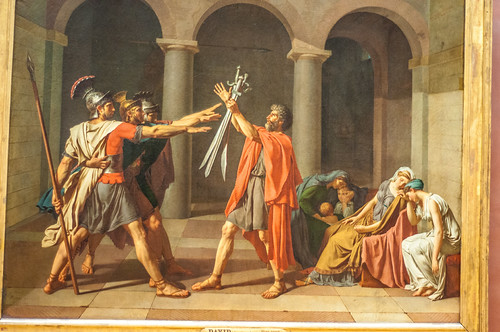
Examples used in the activities include Neoclassical works such as Oath of the Horatii by Jacques-Louis David and Psyche Awakened by Cupid’s Kiss by Antonio Canova, and Romantic works such as The Raft of the Medusa and Charging Chasseur by Géricault, Saturn Devouring His Son by Goya, and Departure of the Volunteers by François Rude.
Neoclassical architecture
Neoclassical architecture began in the mid-18th century, turning away from the grandeur of Rococo and Late Baroque. It drew on the buildings of Classical Greece and Rome and on the Italian architect Andrea Palladio. The module describes three types:
- Temple style: buildings based on an ancient temple.
- Palladian style: based on Palladio’s villas; some have a balustrade, a railing with vertical supports (balusters) along the edge of a flat or low roof.
- Classical block style: a rectangular or square plan with a flat roof and repeated arches or columns, giving the look of a large decorated block.
Two ways to make a sculpture
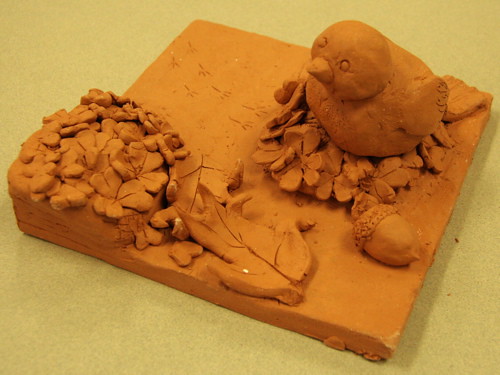
- Additive method: materials are put together to build the form, through modelling, constructing, and assembling.
- Subtractive method: a solid block is cut, chiseled, chipped, or scraped away to reveal the form.
Influence on Philippine art
Lesson 2 explains that the realism in the works of David, Ingres, Géricault, Delacroix, and Goya influenced many Filipino artists. Famous Philippine artworks featured in the module are:
- The Christian Virgins Being Exposed to the Populace by Felix Hidalgo
- Spoliarium by Juan Luna
- Oblation by Guillermo Tolentino
- Pambansang Bantayog ni Andres Bonifacio (Bonifacio National Monument) by Guillermo Tolentino
- Siyam na Diwata ng Sining (nine muses of art) by Napoleon Abueva
The activities pair foreign and local works for comparison, such as The Raft of the Medusa with Fernando Amorsolo’s Planting Rice with Mayon Volcano, and Rude’s Departure of the Volunteers with Tolentino’s Oblation.
How to use this module
The module asks learners to write all answers in an exercise notebook or on a separate sheet and to keep the module free of marks.
- Start with What I Know, a 5-item multiple-choice test and a 5-item matching test on art media such as oil paint, watercolor, acrylic, engraving, and sculpting.
- In Lesson 1, sort words into Neoclassic or Romantic columns, label artworks as RP (Romantic Period) or NP (Neoclassic Period), then study the comparison tables.
- Do Activity 4: Carving from the Past, a sculpture of a human, mythological, or animal figure in clay, soap, wood, or another pliable material, scored for quality, visual impact, punctuality, and neatness.
- Paint or sketch a Neoclassic or Romantic work about safety against COVID-19 on a quarter sheet of white cartolina, display it at home, and ask three family members to rate it with the rubric.
- Evaluate Corot’s A Road at a Ville and Van Gogh’s Starry Night using the nine elements in the table.
- In Lesson 2, match artists to artworks, answer the reflection questions, fill in the artists’ techniques and styles table, and finish the performance task: an artwork of hope and encouragement for COVID-19 victims.
Learners should check their pretest and the matching and labeling activities against the answer key at the end, honestly and only after answering. Parents can help by serving as the family evaluators for the home exhibit. Teachers can use the rubrics provided to grade the sculpture and the painting.
Frequently asked questions
What grade and quarter is this Arts module for?
It is for Grade 9 Arts, Quarter 3, Module 3. It was developed by DepEd Region X as a First Edition, 2020 Alternative Delivery Mode module.
What is the main difference between Neoclassic and Romantic art?
The module sums it up as reason versus passion. Neoclassic art is calm and orderly, with sharp lines and smooth surfaces, while Romantic art is emotional and dramatic, with rich color and visible brushstrokes.
Which Filipino artists are discussed in the module?
Lesson 2 features Felix Hidalgo, Juan Luna, Guillermo Tolentino, and Napoleon Abueva, and an activity uses Fernando Amorsolo’s Planting Rice with Mayon Volcano.
Does the module have an answer key?
Yes. It has answers for the pretest, the word-sorting activity, the Label Me activity, and the Lesson 2 matching activity. The art activities are scored with rubrics instead.
What artworks do learners make in this module?
Learners make a sculpture using the additive or subtractive method, a painting or sketch about COVID-19 safety for a home exhibit, and a final artwork of hope for COVID-19 victims.
Full text of the module
The text below is a transcription of the PDF above, as printed.
Arts Quarter 3 – Module 3: Techniques and Styles of Neoclassic and Romantic Art and its Influence to Philippine Art Forms
CO_Q3_Arts 9_ Module 3
[illustration: students reading and studying under a tree, at a desk with a teacher, and beside a globe]
Arts – Grade 9 Alternative Delivery Mode Quarter 3 – Module 3: Techniques and Styles of Neoclassic and Romantic Art and its Influence to Philippine Art Forms First Edition, 2020
Republic Act 8293, section 176 states that: No copyright shall subsist in any work of the Government of the Philippines. However, prior approval of the government agency or office wherein the work is created shall be necessary for exploitation of such work for profit. Such agency or office may, among other things, impose as a condition the payment of royalties.
Borrowed materials (i.e., songs, stories, poems, pictures, photos, brand names, trademarks, etc.) included in this module are owned by their respective copyright holders. Every effort has been exerted to locate and seek permission to use these materials from their respective copyright owners. The publisher and authors do not represent nor claim ownership over them.
Published by the Department of Education Secretary: Leonor Magtolis Briones Undersecretary: Diosdado M. San Antonio
Development Team of the Module
Authors: Noime Jane G. Langanlangan, Grace A. Austria Content Editor: Nanette Kay D. Mercado Layout Artist: Gianna Norma Stefani D. Mercado, Ma. Jayvee A. Garapan Management Team: Arturo B. Bayocot, Mala Epra B. Magnaong, Marie Emerald A. Cabigas, Bienvenido U. Tagolimot, Jr., Henry B. Abueva, Rustico Y. Jerusalem, Virginia N. Nadayag
Printed in the Philippines by ________________________
Department of Education – Region X Office Address: Masterson Avenue, Upper Balulang, Zone 1, Cagayan de Oro City Telephone: (088)-856-3932 E-mail Address: region10@deped.gov.ph
9
Arts
Quarter 3 – Module 2: Techniques and Styles of Neoclassic and Romantic Art and its Influence to Philippine Art Forms
transcriber’s note: this title page is printed as “Module 2”; the other pages of this module are printed as “Module 3”.
Introductory Message
This Self-Learning Module (SLM) is prepared so that you, our dear learners, can continue your studies and learn while at home. Activities, questions, directions, exercises, and discussions are carefully stated for you to understand each lesson.
Each SLM is composed of different parts. Each part shall guide you step-by-step as you discover and understand the lesson prepared for you.
Pre-tests are provided to measure your prior knowledge on lessons in each SLM. This will tell you if you need to proceed on completing this module or if you need to ask your facilitator or your teacher’s assistance for better understanding of the lesson. At the end of each module, you need to answer the post-test to self-check your learning. Answer keys are provided for each activity and test. We trust that you will be honest in using these.
In addition to the material in the main text, Notes to the Teacher are also provided to our facilitators and parents for strategies and reminders on how they can best help you on your home-based learning.
Please use this module with care. Do not put unnecessary marks on any part of this SLM. Use a separate sheet of paper in answering the exercises and tests. And read the instructions carefully before performing each task.
If you have any questions in using this SLM or any difficulty in answering the tasks in this module, do not hesitate to consult your teacher or facilitator.
Thank you.
What I Need to Know
[illustration: hand with a pointing finger inside a circle]
OBJECTIVES
At the end of this module, the learners are expected to:
- create artworks guided by techniques and styles of Neoclassic and Romantic art traditions.;
- applies different media techniques and processes to communicate ideas, experiences, and stories showing the characteristics of Neoclassic and Romantic periods.;
- evaluates works of art in terms of artistic concepts and ideas using criteria from Neoclassic and Romantic periods.; and
- participates in an exhibit using completed artworks with Neoclassic and Romantic periods characteristics.
What I Know
[illustration: hand holding a pencil inside a circle]
I. MULTIPLE CHOICE
Directions: Write the letter of your answers in your exercise notebook.
_____1. The word neoclassic came from the Greek neos meaning new and the Latin word classicus which means _____?
- A. Light
- B. Old
- C. First class
- D. Bright
_____2. The Neoclassical movement coincided with the 18th century Age of Reason also known as the _____?
- A. Age of Enlightenment
- B. Age of Development
- C. Age of Bold Styles
- D. Age of Classics
_____3. Neoclassical art pieces such as paintings, sculpture and architecture generally portrayed _____?
- A. Greek history
- B. Roman History
- C. Philippine history
- D. Italian history
_____4. These are the characteristics of a neoclassical art EXCEPT
- A. Local color
- B. Overall lighting
- C. Classic geo-structure
- D. Emotional extremes
_____5. This style of Romantic painting became more popular due to the peoples’ romantic adoration of nature.
- A. Landscape painting
- B. Formal painting
- C. Portrait painting
- D. Emotional painting
II. MATCHING TYPE
Direction: Match the following art medium/art techniques in column A with their corresponding meaning in column B. Write the letter of the correct answers in your exercise notebook.
| Column A | Column B |
|---|---|
| _____ 1. Oil paint | A. It is a fast-drying paint made of pigment suspended in acrylic polymer emulsion. |
| _____ 2. Watercolor | B. The process or art of cutting or carving a design on a hard surface, especially so as to make a print. |
| _____ 3. Acrylic paint | C. It is a type of slow-drying paint that consists of particles of pigment suspended in a drying oil, commonly linseed oil. |
| _____ 4. Engraving | D. A painting material which uses water as dispersion of the binding material (such as glue, casein, or gum). |
| _____ 5. Sculpting | E. creating a three-dimensional artwork by means of carving, casting, or other shaping techniques. |
Lesson 1: Elements and Principles of Arts in Neoclassical and Romantic Periods
What’s In
[illustration: hand holding a puzzle piece inside a circle]
Classify the given words inside the box whether they belong to Neoclassical period or the Romantic period. Write your answers in your exercise notebook.
Word box:
- Reason
- Individual freedom
- Tradition
- Values myth, legend, and folk culture
- Constraint
- Power of the imagination
| NEOCLASSIC PERIOD | ROMANTIC PERIOD |
|---|---|
| 1. _____________________________ | 1. _____________________________ |
| 2. _____________________________ | 2. _____________________________ |
| 3. _____________________________ | 3. _____________________________ |
| 4. _____________________________ | 4. _____________________________ |
| 5. _____________________________ | 5. _____________________________ |
transcriber’s note: the word box is printed as two columns of three words each. The left column is listed first, then the right column.
Words listed in the box also include “Feelings over intuition”, “Logic”, “Lessons of the past”, and “Rules and Order” in the printed box.
What’s New
ACTIVITY 1: “Label Me!”
IDENTIFICATION: Considering the techniques and styles used in the following movement, write RP if the artwork belongs to the Romantic Period and NP if it belongs to the Neoclassic Period. Write your answer in your exercise notebook.
[photo: marble sculpture of a winged figure bending over a reclining woman]
https://www.flickr.com/photos/chilangoco/7856522628
PSYCHE AWAKENED BY CUPID’S KISS (A. Canova)
ANSWER:[photo: relief sculpture of a group of soldiers and figures rising with a winged figure above]
https://www.flickr.com/photos/69184488@N06/11891328224
DEPARTURE OF THE VOLUNTEERS (F. Rude)
ANSWER:[photo: sculpture of a warrior wrestling a minotaur]
https://www.flickr.com/photos/internetarchivebookimages/14589711690/
THESEUS SLAYING MINOTAUR (A. Barye)
ANSWER:[photo: painting of three armed men raising their hands in an arched hall, with women mourning at the right]
https://www.flickr.com/photos/graeme/8532843567
OATH OF THE HORATII (J. David)
ANSWER:[photo: painting of a mounted soldier charging across a field]
https://www.flickr.com/photos/carles_tomas/2694479035
CHARGING CHASSEUR (T. Géricault)
ANSWER:[photo: painting of a rearing horse with a rider pointing toward a mountain pass]
https://www.flickr.com/photos/graeme/8532843567
NAPOLEON CROSSING THE ALPS (J. David)
ANSWER:
:
transcriber’s note: the Oath of the Horatii and Napoleon Crossing the Alps entries print the same Flickr URL, as in the original.
What is It
Neoclassical and Romantic styles are very different from each other. This was introduced to you on the previous modules. This is a summary of the qualities particularly techniques and styles of art from Neoclassicism and Romanticism.
| ELEMENTS | NEOCLASSICISM | ROMANTICISM |
|---|---|---|
| Values: | Order, solemnity | Intuition, emotion, imagination |
| Inspiration: | Classical Rome, patriotism, courage, honor | Medieval and Baroque eras, Middle and Far East |
| Tone: | Calm, rational | Subjective, spontaneous, non-conformist |
| Subjects: | Greek and Roman history | Legends, exotica, nature, violence |
| Technique: | Stressed drawing with lines, not color; no trace of brushstroke | Unrestrained, rich color; visible brushstrokes |
| Role of art: | Morally uplifting, inspirational | Dramatic, carry viewer away |
| Composition: | Most figures in foreground. | Use of diagonal, crowded compositions |
| Lines: | Linear style (outlines are sharply defined through controlled brushstrokes) | Painterly style (brushstrokes are less restrained) |
| Texture: | Smooth, no brushstrokes can be seen | Often has visible brushstrokes |
[photo: Saturn Devouring His Son painting by F. Goya] https://www.flickr.com/photos/nat507/27210599170 SATURN DEVOURING HIS SON (F. Goya) ANSWER:
[photo: The Raft of the Medusa painting by T. Géricault] https://www.flickr.com/photos/archer10/16237617902 THE RAFT OF THE MEDUSA (T. Géricault) ANSWER:
NEOCLASSICISM versus ROMANTICISM
| Neoclassicism: REASON | Romanticism: PASSION |
|---|---|
| Nature is defined as human nature | Nature is defined as natural environment (woods, mountains, etc) |
| Society is more important than the individual | The individual is more important than society |
| Imitation | Originality |
| Tradition | Experimentation |
| Rules and order | Freedom |
| Mechanical form (imposed from outside) | Organic form (growing from inside) |
| Logic | Intuition |
| Reason | Imagination, Emotion |
| Attempted objectivity | Accepted subjectivity |
| Town or cultivated landscape | Country, preferably untouched nature |
| Constraint | Spontaneity |
| Conformity | Independence, Rebellion |
| Cultivated, formal, social | The primitive becomes focus |
NEOCLASSICAL SCULPTURE versus ROMANTIC SCULPTURE
| Neoclassical | Romantic |
|---|---|
| Mythological Characters | Human world |
| Religious Characters | Natural world |
| Portraying discrete sexual pleasures | Dynamic and emotional |
| Nude flesh | Animal themes |
NEOCLASSICAL ARCHITECTURE
Neoclassical architectural styles started in the mid-18th century. It turned away from the grandeur of Rococo style and the Late Baroque. In its purest form, Neoclassical architecture was a style principally derived from the architecture of Classical Greece and Rome and the architectural designs of the Italian architect Andrea Palladio.
Types of Neoclassical Architecture: Temple Style
Temple style building design was based on an ancient temple. These buildings were uncommon during the Renaissance as architects of that period focused mainly on applying classical elements to churches and modern buildings like palazzos and villas.
Palladian Style
Palladian buildings were based on Andrea Palladio’s style of villa construction. Some of the buildings feature a balustrade which is a railing with vertical supports along the edge of the roof. There are vertical supports within a balustrade known as “balusters” or spindles”. It is also a classical method of crowning a building that has a flat or low lying roof.
Classical Block Style
The building features a rectangular or square plan, with a flat roof and an exterior rich in classical detail. The exterior features a repeated classical pattern or series of arches and/or columns. The overall impression of such a building was a huge, classically-decorated rectangular block.
What’s More
ACTIVITY 4: “Carving from the Past”
Create your own sculpture, either human, mythological, or animal figures.
Material: Choose your material as to your preference such as modeling clay, soap, piece of wood, rock, wire or any usable and pliable medium.
Sculpture is an art form showing the three-dimensional representation of an image. It is free standing and can be seen from different angles. There are two sculptural processes, namely additive and subtractive.
Additive method is when materials are put up together to form the image. This method is done through modelling, constructing, and assembling to build the form.
[photo: clay sculpture of a bird and leaves on a base] https://www.flickr.com/photos/teitelbaum/4594424568
[photo: figure sculpture made of colored paper collage] https://www.flickr.com/photos/melanie-gail/6917959265/
Subtractive method is when a solid block or mass of material is cut, chiseled, chipped or scraped away to reveal the remaining form.
[photo: wooden sculpture of a rearing horse] Wooden sculpture of horse stock image. Image of aggressive – 19419029 (dreamstime.com)
[photo: carved pale stone sculpture of a figure] https://www.flickr.com/photos/scul210/4581037989/
Procedures:
- Use knife or cutter in carving-out your art piece.
- Design should reflect the style of the Neo-classic and Romantic period.
- You may also use patterns that shows your regional identity.
- Exhibit/Display your masterpiece.
RUBRICS
| CRITERIA | 5 | 4 | 3 | 2 |
|---|---|---|---|---|
| QUALITY OF ARTWORK | All instructions were followed correctly | 1-2 instructions were not followed correctly | 3-4 instructions were not followed correctly | Most of the instructions were not followed correctly |
| VISUAL IMPACT | Artwork has shown a Neoclassical/Romantic style/technique. | Artwork has somehow shown a Neoclassical/Romantic style/technique. | Artwork-has rarely shown a Neoclassical/Romantic style/technique. | Artwork has not shown a Neoclassical/Romantic style/technique. |
| PUNCTUALITY | Artwork was submitted on time | Artwork was submitted 1 day late | Artwork was submitted 2 days late | Artwork was submitted 3 days late |
| NEATNESS | Artwork presentation was neat and orderly | Artwork presentation was mostly neat and orderly | Artwork presentation was somehow neat and orderly | Artwork presentation was disorderly |
| DESCRIPTIVE RATING | SCORE/POINTS |
|---|---|
| Excellent | 18-20 |
| Very Good | 15-17 |
| Good | 11-13 |
| Fair | 9-10 |
| Poor | 8 |
Reflection Questions:
- What sculpting technique did you use to show the style of the Neoclassicism/Romanticism?
- Why do you think the subject in your work is reflective of Neoclassicism/Romanticism style?
- How did you apply the elements of arts to show the distinct technique of the Neoclassicism/Romanticism art style?
What I Have Learned
Activity: “Exhibit”
Paint or sketch a work of art that characterizes Neoclassicism or Romanticism which conveys safety against the pandemic Covid19. Give a title and a short portrayal about your work. Find a space in your house where you can display/exhibit your artwork. Choose 3 members of the family to assess your work using the rubrics below.
Materials:
- ¼ white cartolina
- Painting/colouring materials
Reflections:
- What did you feel as you were making your perfect work of art?
- Does your work of art pass on the techniques and styles of Neoclassicism or Romanticism?
RUBRICS
| CRITERIA | 5 | 3 | 1 |
|---|---|---|---|
| NATURE OF ARTWORK | All instructions were followed correctly. | Some instructions were not followed correctly. | Most of the instructions were not followed. |
| VISUAL EFFECT | Artwork shows the idea of the presented period. | Artwork somehow shows the idea of the presented period. | Artwork did not show the idea of the presented period. |
| TIDINESS | Artwork was clean and orderly. | Artwork was somehow clean and orderly. | Artwork was disorderly. |
| TIMELINESS | Artwork was given on time. | Artwork was given 1 day late. | Artwork was given 2 days late. |
| Descriptive Rating | Score/Points |
|---|---|
| Excellent | 18 – 20 |
| Very Good | 15 – 17 |
| Good | 11 – 13 |
| Satisfactory | 9 – 10 |
| Needs Improvement | 8 and below |
What I Can Do
Evaluate the techniques and styles of the artworks below. How did the Neoclassical and Romantic art styles and techniques influence these two works in the pre-impressionism and post-impressionism eras?
A ROAD AT A VILLE (1874) by Jean-Baptiste-Camille Corot
[photo: landscape painting of a road with trees and figures] https://www.flickr.com/photos/pedrosimoes7/28222916085
transcriber’s note: the answer table below has no printed header row; its header cells are left empty.
| VALUES | |
| INSPIRATION | |
| TONE | |
| SUBJECTS | |
| TECHNIQUE | |
| ROLE OF ART | |
| COMPOSITION | |
| LINES | |
| TEXTURE |
STARRY NIGHT (1889) by Van Gogh
[photo: painting of a swirling night sky over a village with a cypress tree] https://en.wikipedia.org/wiki/The_Starry_Night#/media/File:Van_Gogh_-_Starry_Night_-_Google_Art_Project.jpg

transcriber’s note: the answer table below has no printed header row; its header cells are left empty.
| VALUES | |
| INSPIRATION | |
| TONE | |
| SUBJECTS | |
| TECHNIQUE | |
| ROLE OF ART | |
| COMPOSITION | |
| LINES | |
| TEXTURE |
Lesson 2: The Influence of Neoclassic and Romantic Artists to Philippine Art Forms
What I Need to Know
OBJECTIVES
At the end of this module, the learners are expected to:
- Describe the influence of iconic artists belonging to the Neoclassic and Romantic periods.
- Shows the influence of Neoclassic and Romantic periods on Philippine art forms.
What’s In
The Neoclassical period was one of the great ages of public sculpture. Artists looked to Roman styles during the time of Alexander the Great for inspiration and mimic their style. The paintings of the Romantic period gave more emphasis on emotion. Artists expressed as much feeling and passion as they could on canvas.
Can you still remember these Neoclassic and Romantic artists?
In your activity notebook match the following artists in column A with their corresponding artworks in column B. Write the letter of the correct answer.
| Column A | Column B |
|---|---|
| _____ 1. Delacroix | A. Charging Chasseur |
| _____ 2. Barye | B. The Burial of Sardine |
| _____ 3. Gericault | C. Liberty Leading the People |
| _____ 4. Goya | D. Theseus Slaying Minotaur |
| _____ 5. David | E. Napoleon Crossing the Alps |
What is It
NEOCLASSICISM and ROMANTICISM in the Philippines
In the Philippines, Neoclassic and Romantic arts influenced a lot of our artists. The realism employed in the styles and techniques of the works of Jacques-Louis David, Jean-Auguste-Dominique Ingres, Jean Louis Théodore Géricault, Eugène Delacroix, Francisco Goya shows in their paintings, sculptures, and architecture.
FAMOUS PHILIPPINE ARTWORKS:
[photo: painting of nude figures being led through a stone hall] https://commons.wikimedia.org/wiki/File:Las_Virgenes_Cristianas_Expuestas_Al_Populacho_(The_Christian_Virgins_Being_Exposed_to_the_Populace)_by_Felix_Ressureccion_Hidalgo_1884.jpg THE CHRISTIAN VIRGINS BEING EXPOSED TO THE POPULACE (FELIX HIDALGO)

[photo: large dark painting of a crowd around fallen bodies] https://commons.wikimedia.org/wiki/File:Juan_Luna_Spoliarium.jpg SPOLARIUM (JUAN LUNA)

[photo: bronze statue of a nude male figure with outstretched arms] https://commons.wikimedia.org/wiki/File:UP_Baguio_Oblation.jpg OBLATION (GUILLERMO TOLENTINO)

[photo: monument of figures around a tall column] https://commons.wikimedia.org/wiki/File:Pambansang_Bantayog_ni_Andres_Bonifacio_(Bonifacio_National_Monument).jpg PAMBANSANG BANTAYOG NI ANDRES BONIFACIO (GUILLERMO TOLENTINO)

[photo: circular monument with figures on a pavilion of columns] https://commons.wikimedia.org/wiki/File:UP_CALjf3065_10.JPG SIYAM NA DIWATA NG SINING (NAPOLEON ABUEVA)

What’s More
ACTIVITY 1: “Say Something about the Styles”
[photo: Liberty Leading the People painting] https://www.pinterest.ph/pin/304204149800621177 LIBERTY LEADING THE PEOPLE (E. Delacroix)
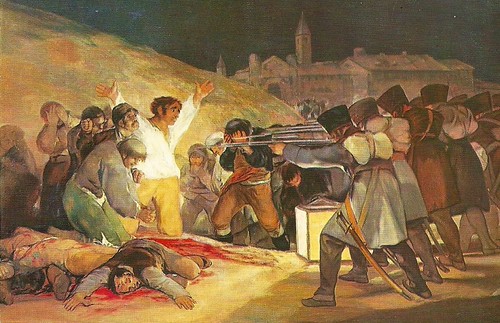
[photo: The Third of May painting] https://www.flickr.com/photos/nat507/27452992236 THE THIRD OF MAY (F. Goya)
Reflection Questions: Write your answers in your exercise notebook.
- What can you say about the artwork’s styles of the Neoclassic and Romantic Period?
- What specific style was portrayed in each work of art?
- How did the artists convey their styles in their art?
Activity 2: “Neoclassicism Technique in a Philippine Painting”
NEOCLASSICAL PAINTING
[photo: The Raft of the Medusa painting] https://www.flickr.com/photos/archer10/16237617902 THE RAFT OF THE MEDUSA (T. Géricault)
PHILIPPINE PAINTING
[photo: Planting Rice with Mayon Volcano painting] PLANTING RICE WITH MAYON VOLCANO (F. Amorsolo) METROPOLITAN MUSEUM OF MANILA
Reflection Questions: Write your answers in your exercise notebook.
- What can you say about Neoclassical and Philippine paintings?
- Compare each artwork according to their respective techniques and styles.
Activity 3: “Romanticism Technique in a Philippine Sculpture”
ROMANTIC SCULPTURE
[photo: Departure of the Volunteers sculpture relief] https://www.flickr.com/photos/69184488@N06/11891328224 DEPARTURE OF THE VOLUNTEERS (F. Rude)
PHILIPPINE SCULPTURE
[photo: Oblation sculpture] https://www.flickr.com/photos/andryn2006/308544959 OBLATION (University of the Philippines) (G. Tolentino)
Reflection Questions:
- Which work shows a Romanticism technique? Why?
- How did the Romanticism technique influenced Philippine sculptures?
- Give other examples of sculptures with influences of the sculptural techniques of Romanticism art in our country.
What I Have Learned
“Artists’ Techniques and Styles”
Write the technique or style of art of each artist.
| ARTIST | TECHNIQUE | STYLE |
|---|---|---|
| Neoclassic Artists | ||
| Jacques-Louis David | ||
| Antonio Canova | ||
| Bertel Thorvaldsen | ||
| Romantic Artists | ||
| Francisco Goya | ||
| Jean-Baptiste-Camille Corot | ||
| François Rude |
[transcriber’s note: table continued from the previous page]
| ARTIST | TECHNIQUE | STYLE |
|---|---|---|
| Philippine Artists | ||
| Guillermo Tolentino | ||
| Felix Hidalgo | ||
| Napoleon Abueva | ||
| Juan Luna |
Reflection Questions:
- Among the artists listed in the table, who would be your best choice? And why?
- If you would be an artist, what would be the theme of your artworks? And why?
What I Can Do
PERFORMANCE TASK: “Timely Challenge”
Neoclassic and Romantic artists influenced other artists. Now, it is your turn to create an artwork for the victims of covid-19. The content should display positivity, hope and encouragement to continue fighting for this pandemic. Apply the techniques and styles of Neoclassic and Romantic art conventions that you have gained from this lesson.
[transcriber’s note: an empty rounded box is printed here for the learner’s artwork]
Answer Key
[transcriber’s note: the answer key boxes are printed upside down; each box below was read after turning it 180 degrees]
LESSON 1
WHAT I KNOW
| Item | I. MULTIPLE CHOICE | II. MATCHING TYPE |
|---|---|---|
| 1 | C | C |
| 2 | A | D |
| 3 | B | A |
| 4 | D | B |
| 5 | A | E |
WHAT’S IN
| NEOCLASSIC PERIOD | ROMANTIC PERIOD |
|---|---|
| Reason | Individual freedom |
| Tradition | Lessons of the past |
| Rules and order | Values myth, legend, and folk culture |
| Constraint | Power of the imagination |
| Logic | Feelings over intuition |
WHAT’S NEW
“LABEL ME!”
Answer: RP Answer: RP Answer: RP Answer: NP Answer: NP Answer: RP Answer: RP Answer: NP
[transcriber’s note: the eight answers are printed in two columns; they are listed here in the order read from the rotated page]
LESSON 2
WHAT’S IN
- C
- D
- A
- B
- E
References
A. Books:
Music and Arts Grade 9 Learner’s Material
B. Websites: For Pictures




https://commons.wikimedia.org/wiki/File:Juan_Luna_Spoliarium.jpg
https://commons.wikimedia.org/wiki/File:UP_Baguio_Oblation.jpg
https://commons.wikimedia.org/wiki/File:UP_CALjf3065_10.JPG
https://www.flickr.com/photos/andryn2006/30854495933 https://www.flickr.com/photos/nat507/27452992236


Wooden sculpture of horse stock image. Image of aggressive – 19419029 (dreamstime.com), https://www.dreamstime.com/royalty-free-stock-images-wooden-sculpture-horse-image19419029
For inquiries or feedback, please write or call:
Department of Education – Bureau of Learning Resources (DepEd-BLR)
Ground Floor, Bonifacio Bldg., DepEd Complex Meralco Avenue, Pasig City, Philippines 1600
Telefax: (632) 8634-1072; 8634-1054; 8631-4985
Email Address: blr.lrqad@deped.gov.ph * blr.lrpd@deped.gov.ph
Leave a Reply